Skip to Content

Decarbonization & Energy Efficiency


How can shipping reduce its environmental impact ?


Shipping connects the world, carrying goods, energy and people across oceans. But moving ships requires large amounts of energy — and today, much of that energy still comes from fossil fuels.

The maritime industry is therefore facing one of its biggest challenges: how can ships continue to transport the world's trade while significantly reducing their environmental impact?

There is no single solution.

Future marine fuels will play an important role, but decarbonization is about much more than changing fuel. More efficient engines, better ship design, cleaner technologies, digital optimization and smarter operational decisions can all contribute.

For tomorrow's maritime professionals, understanding how these solutions work together will become an increasingly important part of working at sea.

Explore the technologies, operational practices and ideas helping shipping use less energy and reduce emissions.


Every unit of energy matters.

One of the most effective ways to reduce emissions is simple in principle:

Use less energy to move the ship.

In practice, achieving this involves almost every part of a vessel.

The resistance of the hull, efficiency of the propeller, condition of the engine, operation of auxiliary machinery, electrical loads, weather, speed, route and even how equipment is operated can influence overall energy consumption.

A small improvement in one area may seem insignificant.

But when improvements are combined across a ship and maintained throughout its operating life, the impact can become substantial.

Energy efficiency is not one technology. It is a way of looking at the entire ship as an interconnected system.

Explore the solutions


 Efficient Propulsion


Getting more from every unit of energy.

Marine engines and propulsion systems convert fuel or electrical energy into the power required to move a ship.
Their efficiency depends on much more than the engine itself.
Engine loading, combustion, turbocharging, propeller performance, shaft systems and the interaction between machinery and hull all influence how effectively energy is converted into propulsion.

Explore how modern propulsion technologies, engine optimization and improved system integration can reduce energy consumption.

Hull & Propeller Efficiency


Reducing the resistance to movement

A ship must continuously overcome resistance as it moves through water.
Hull form, surface condition, marine growth, propeller design and vessel loading can all affect the amount of power required.
Technologies such as advanced hull coatings, optimized propellers, energy-saving devices and air-lubrication systems aim to reduce these losses.

Even good maintenance can make a difference.


Voyage & Speed Optimization


Sometimes the biggest savings come from operating differently.

Ship speed has a major influence on energy consumption.
Weather, currents, routing, arrival times and port availability can also determine how efficiently a voyage is completed.
Digital voyage-planning and optimization systems can help crews and shore teams make better-informed decisions about speed and route.

The objective is not simply to travel more slowly.

It is to operate the vessel intelligently as part of the complete voyage.


Waste Heat Recovery


Energy that would otherwise disappear.

Large amounts of thermal energy are produced during engine operation.
Instead of allowing all of this heat to escape through exhaust gases and cooling systems, some ships recover part of it for useful purposes.

Waste heat can be used for heating, steam production and, in some installations, electricity generation.

Explore how waste-heat recovery can improve the overall efficiency of a vessel's energy system.


Electrification & Hybrid Systems


Rethinking how ships produce and use power.

Batteries, hybrid propulsion, shore power and increasingly sophisticated electrical systems are changing the traditional relationship between engines and onboard energy.

A hybrid vessel may combine engines, batteries and other energy sources so that each can operate where it is most effective.

For future marine engineers and ETOs in particular, the boundaries between mechanical propulsion, electrical power and automation are becoming increasingly connected.


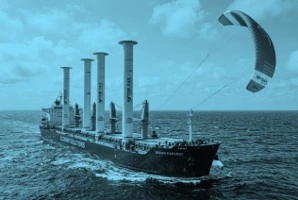
Wind-Assisted Propulsion


Using an old energy source with new technology.

Ships used wind power for thousands of years.
Today, new technologies are bringing wind back to commercial shipping in very different forms.
Rotor sails, rigid sails, wings and towing systems can provide additional propulsion and reduce the power required from the vessel's main machinery.

Wind will not replace engines on most ships, but it may become part of a broader combination of energy-saving technologies.


Carbon Capture


Can emissions be captured onboard?

Instead of preventing carbon dioxide from being produced, onboard carbon-capture technologies aim to separate some CO₂ from a ship's exhaust gases before it reaches the atmosphere.
This creates additional challenges.

Captured CO₂ must be processed, stored onboard and eventually transferred ashore for appropriate handling.

Explore the technology, potential applications and practical challenges behind marine carbon capture.


Alternative Marine Fuels


Changing the source of energy.

Efficiency can reduce the amount of energy a ship needs.
Alternative fuels can change where that energy comes from and the emissions associated with producing and using it.
LNG, methanol, ammonia, hydrogen, biofuels and other energy carriers each present different opportunities and challenges.

Understanding decarbonization therefore requires looking at both energy efficiency and the energy source itself.

Technology or operation ?


We need both.

Some improvements require new equipment.

Others require better use of equipment that is already onboard.

The most effective approach may combine many relatively small improvements rather than relying on one dramatic technological change.

Technical Measures

Operational Measures

These can include:

  • More efficient engines and propulsion systems
  • Propeller and hull improvements
  • Waste-heat recovery
  • Batteries and hybrid systems
  • Wind-assisted propulsion
  • Advanced coatings
  • Energy-saving devices
  • Improved electrical systems
  • Alternative fuels
  • Carbon-capture technologies
These can include:

  • Speed optimization
  • Weather routing
  • Trim and draft optimization
  • Improved voyage planning
  • Machinery optimization
  • Hull and propeller maintenance
  • Efficient use of auxiliary equipment
  • Energy-performance monitoring

Measure. Understand. Improve.


You cannot improve what you do not understand.

Modern ships generate increasing amounts of operational data.

Fuel consumption, shaft power, engine performance, vessel speed, weather conditions, electrical loads and many other parameters can be measured and analysed.

But data alone does not improve efficiency.

The challenge is turning information into better decisions.

Future seafarers will increasingly work with monitoring systems, performance dashboards and decision-support tools that help them understand how efficiently their vessel is operating.

This makes digital competence part of energy efficiency.

From ship to entire lifecycle


Where do the emissions really come from?

Measuring environmental impact is more complicated than looking only at the exhaust coming from a ship.
Energy is also required to produce, process and transport fuels before they reach the vessel.

This is why shipping increasingly considers emissions across the fuel lifecycle.


Tank-to-Wake
What happens from the ship's fuel tank to the energy used onboard?

Well-to-Tank
What emissions are associated with producing and delivering the fuel?

Well-to-Wake
What happens when the complete fuel pathway is considered?

This distinction becomes especially important when comparing alternative fuels.
A fuel may produce very little carbon dioxide onboard but still have significant emissions associated with how it was produced.

Understanding the whole picture matters.

What does this mean for seafarers?


Where do the emissions really come from?

Decarbonization is sometimes discussed as though it were mainly the responsibility of ship designers, regulators and technology companies.

But the people operating ships have an important role too.

Marine engineers influence machinery efficiency, maintenance and energy management.

Deck officers make decisions affecting speed, route, trim and voyage execution.

ETOs work with increasingly sophisticated electrical, automation and energy-management systems.

Ratings interact daily with machinery, maintenance and operational procedures.

And Masters and Chief Engineers bring these different areas together through leadership and operational decision-making.

The energy transition will therefore require not only new technologies — but people who understand how to use them effectively.

Start Learning


Introduction to Maritime Decarbonization


FREE FOUNDATION LEARNING


New to the subject?

Start by understanding the fundamentals of energy use, emissions and efficiency in shipping.

You'll explore:

  • Why shipping is working to reduce greenhouse-gas emissions
  • Where ships use energy
  • Why vessel speed matters
  • How hull and propeller efficiency affects fuel consumption
  • How engines and machinery can operate more efficiently
  • The role of digital monitoring and voyage optimization
  • Alternative fuels and electrification
  • Why human decisions remain important

    [START LEARNING — FREE]

Tomorrow at Sea Live

Learn from the people working on the transition.

How are shipowners improving vessel efficiency today?
Which technologies are delivering measurable results?
How are crews adapting?
And what solutions might become important tomorrow?

Join shipowners, engineers, seafarers, technology specialists, researchers and educators for live discussions about maritime decarbonization and energy efficiency.

Ask questions. Explore the technology. Understand the reality behind the transition.

[SEE UPCOMING LIVE SESSIONS →]

Efficiency starts with understanding.


There may never be one technology that solves shipping's environmental challenges.

Instead, the future is likely to involve combinations of cleaner energy, more efficient ships, smarter operations, digital technologies — and people who understand how to bring them together.

Tomorrow's maritime professionals will be part of that transition.

Start building your understanding today.

Learn. Connect. Prepare.

Mastering Tomorrow at Sea — Powered by GigaMare